Bindning: Häftat band
Bokförlag: Media-Tryck
ISBN: 9789177532859
Omfång: 296 s.
Språk: Engelska
Utgivningsdatum: 2017-05-04
Förlagets information
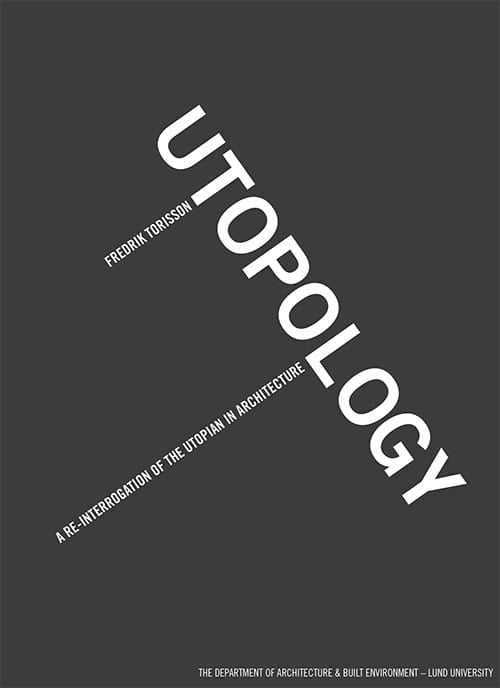
UTOPIA – the word is simultaneously evocative of hope and dread. As a concept it is stupendously problematic, and yet despite its alleged passing into irrelevance, utopia still remains a household word. Why is this so? Utopia has been reduced to a category. We place a solution in the category of the utopian or, conversely, the not-utopian. Without fail, discussions involving utopia will eventually veer toward debates on whether a book, project, or building is utopian or not. Utopia reduced to such a category invokes both a problematic universality and a convoluted end of history – perhaps nowhere more so than in the field of architecture. However, if we begin with the problem to which the solution is a response rather than the solution being proposed, we soon realize that utopia is more complicated than a simple image of a perfect future. The study at hand re-interrogates the utopian concept. The question is not what architecture is utopian, but how and why architecture is utopian. Utopia is reinterpreted as a concept predicated on survival and a desire for a better way of living, rather than on immortality and perfection. Utopia in this sense is monstrous; its function is to challenge the presuppositions that define the horizons of our imagination, and to show us that the future is not predetermined: the future is fundamentally open. What assumptions, then, are formative of how architects relate to the future and utopia when projections of that future perfect have become irrelevant? If the projection of a perfect future is impossible, yet intimately associated with the architect, utopia becomes paradoxical for architects. Utopian desire is instead expressed in other ways, consciously or unconsciously. The study argues that the present worldview is dominated by what is here dubbed the Network-image; we think of everything in terms of networks, privileging connections over form, and the architect is again assuming a new role for herself as a manager, rather than an expert. Networks offer different ways of working with architecture. Rather than specifying the forms of the future (projections), architects can and do work by defining and elaborating protocols that enable and cultivate connections which, according to the prevalent narrative, build transversal collectives that can potentially transform the world. However, there are other implications linked to these new opportunities. Any network is governed by multiple protocols, and the architect as manager becomes inscribed in a logic of control. There is an implicit notion that architects can produce architecture that is self-governing, participatory, and implicitly egalitarian (and instrumental in opening up the future) through designing protocols. This assumption urgently needs to be interrogated. The discussion in this study centers on the need to challenge the Network-image itself, and not only to take our role in it as given. The dissertation is an argument for considering the how of imagining the future with more scrutiny, and it offers a set of principles and a terminology for discussion to enable further research on the subject.
UTOPIA – the word is simultaneously evocative of hope and dread. As a concept it is stupendously problematic, and yet despite its alleged passing into irrelevance, utopia still remains a household word. Why is this so? Utopia has been reduced to a category. We place a solution in the category of the utopian or, conversely, the not-utopian. Without fail, discussions involving utopia will eventually veer toward debates on whether a book, project, or building is utopian or not. Utopia reduced to such a category invokes both a problematic universality and a convoluted end of history – perhaps nowhere more so than in the field of architecture. However, if we begin with the problem to which the solution is a response rather than the solution being proposed, we soon realize that utopia is more complicated than a simple image of a perfect future. The study at hand re-interrogates the utopian concept. The question is not what architecture is utopian, but how and why architecture is utopian. Utopia is reinterpreted as a concept predicated on survival and a desire for a better way of living, rather than on immortality and perfection. Utopia in this sense is monstrous; its function is to challenge the presuppositions that define the horizons of our imagination, and to show us that the future is not predetermined: the future is fundamentally open. What assumptions, then, are formative of how architects relate to the future and utopia when projections of that future perfect have become irrelevant? If the projection of a perfect future is impossible, yet intimately associated with the architect, utopia becomes paradoxical for architects. Utopian desire is instead expressed in other ways, consciously or unconsciously. The study argues that the present worldview is dominated by what is here dubbed the Network-image; we think of everything in terms of networks, privileging connections over form, and the architect is again assuming a new role for herself as a manager, rather than an expert. Networks offer different ways of working with architecture. Rather than specifying the forms of the future (projections), architects can and do work by defining and elaborating protocols that enable and cultivate connections which, according to the prevalent narrative, build transversal collectives that can potentially transform the world. However, there are other implications linked to these new opportunities. Any network is governed by multiple protocols, and the architect as manager becomes inscribed in a logic of control. There is an implicit notion that architects can produce architecture that is self-governing, participatory, and implicitly egalitarian (and instrumental in opening up the future) through designing protocols. This assumption urgently needs to be interrogated. The discussion in this study centers on the need to challenge the Network-image itself, and not only to take our role in it as given. The dissertation is an argument for considering the how of imagining the future with more scrutiny, and it offers a set of principles and a terminology for discussion to enable further research on the subject.